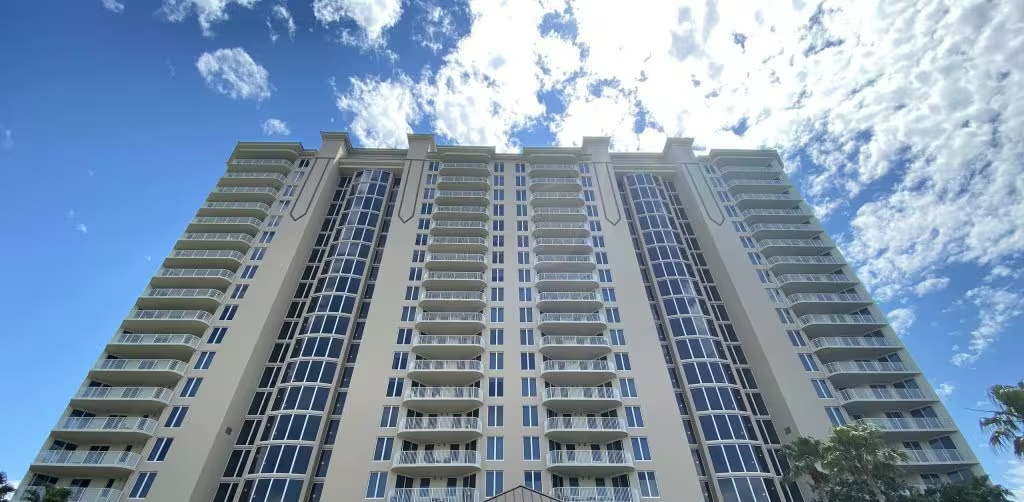
One Beach Club Drive condominium tower seen from grade, stacked balconies and window wall against a bright coastal sky, Miramar Beach, Florida.
WATERPROOFING & RESTORATION

Building envelope waterproofing and concrete restoration.

Salt aerosol, wind-driven rain, UV, and thermal cycling drive spalling, sealant failure, and water intrusion on every building on this coast. We investigate the cause, document the condition, sequence the repair, and stay through construction. This is the work we do most, on the coast where we practice.

What fails on the Gulf Coast

Six failure modes account for most of the envelope repair work we see on this coast.

Coastal buildings fail in patterns, and the patterns are diagnosable before they become emergencies.

Chloride-driven corrosion of embedded steel

Salt aerosol reaches concrete for miles inland. Once chlorides penetrate to the reinforcing, the steel expands as it corrodes and drives the concrete off. It shows first at slab edges, balcony noses, and railing embedments, and it is usually further along than the surface suggests. We sound the concrete, map the delaminated area, and quantify it before anyone prices a repair.

Balcony coatings and negative slope

Traffic coatings on the Gulf take UV, thermal cycling, and standing water at the same time. When the coating fails at the perimeter sealant or the slab drains back toward the door, water sits on the slab and reaches the reinforcing. We check the slope, the terminations, and the drainage behind the coating.

Wind-driven rain at openings

Coastal rain arrives horizontally. Window and slider perimeters, through-wall penetrations, and railing anchors leak under pressure long before they leak under a hose. We test where the water is entering before anything gets recoated.

Sealant joints past their service life

Joint sealant is a wear item, and on a west-facing Gulf elevation it wears fast. Failed joints at expansion joints, control joints, and panel edges quietly load the wall assembly for years. Joint condition is inventoried by elevation so replacement can be scheduled.

Roofs, parapets, and uplift terminations

Most roof problems on this coast start at the edge: base flashings, parapet caps, and mechanical terminations that loosen under uplift. Catching that at the right point in the roof's life is the difference between a repair and a full replacement.

Storm damage hidden behind cladding

After a named storm, the visible damage is rarely the expensive damage. Stucco cracking, saturated sheathing, and displaced flashing sit behind an intact-looking wall. Documentation gathered early is what an association needs for both the repair and the insurance file.

Everyone in the building needs the same answers, early.

Owners & boards

You need four answers: whether the building is safe, what has to be corrected now, what can be scheduled, and what it costs. We deliver findings a board can vote on, present them at your meeting, and leave you documentation that holds up with owners, insurers, and lenders.

Community association managers

An engineer who answers the phone, comes to the property, and writes reports you can forward without editing. We handle the traffic among owners, boards, and contractors, and we phase disruptive work around rental season.

Contractors

Repair documents built to be bid and built: defined scope, real details, workable phasing on occupied buildings. Apples-to-apples bid tabulations and Contract Administration that keeps good contractors paid for work done right.

Our restoration methodology

Diagnose the mechanism. Then specify the repair.

  1. 01

    Review and validation of existing conditions

    We read what already exists: prior reports, testing data, repair history. Then we verify it ourselves, with close visual review, sounding, and drone and high-resolution aerial documentation of elevations no ladder reaches. Less disruption to residents, a better picture of the building.

  2. 02

    Diagnosis before prescription

    Testing is scoped to the question in front of us: moisture readings, infrared thermography by certified thermographers, water testing at suspect openings, and selective openings where the assembly has to be seen. We name the mechanism causing the failure before we specify a repair for it.

  3. 03

    Prioritization and phased planning

    Findings sort by life safety, active water intrusion, structural durability, code compliance, and budget reality. We also flag lower-priority conditions that get resolved incidentally by higher-priority work, which removes duplicate mobilization and redundant cost.

  4. 04

    Repair development and construction documents

    Repair details, specifications, and phasing plans written for occupied coastal buildings: quantified unit-price repair items so the association is not exposed on change orders, and terminations detailed for the exposure the elevation actually gets.

  5. 05

    Bidding and bid tabulation

    Contractor qualification, insurance and bonding criteria, resident coordination, work hours, staging, and emergency procedures are settled before bidding. Bids come back organized for a direct comparison, because, on an occupied building, contractor logistics matter as much as the repair design.

  6. 06

    Contract Administration and closeout

    Construction Observations, weekly progress meetings with distributed minutes, pay application review, punch lists, and a complete closeout package: warranties, record documents, maintenance schedules, and testing reports. How Contract Administration works

The services, one by one.

Milestone Inspections

Structural inspections required by Section 553.899, Florida Statutes, for aging condominium buildings, led by a licensed engineer who is also a Florida Special Inspector. Phase 1 visual examination; Phase 2 testing and analysis if warranted; reporting written for boards and building officials.

Related · Emerald Towers West · Tides at TOPS'L

Structural Integrity Reserve Studies and full reserve studies

Structural Integrity Reserve Studies (SIRS) under Section 718.112(2)(g), Florida Statutes, and full reserve studies. Our Community Asset Consulting team is led by a former community association manager who knows how boards budget.

Related · High Pointe · One Beach Club Drive

Exterior Building Envelope Condition Surveys

A documented, prioritized picture of what your envelope is doing: moisture intrusion diagnostics, infrared thermography by certified thermographers, balcony and deck evaluations, roof evaluations, and wind mitigation reviews.

Related · Emerald Towers West · The Oaks at Niceville

Construction Documents

Repair details, specifications, and bid documents tailored for occupied high-rise restoration. Built to be priced, built, and enforced.

Related · Luau · One Beach Club Drive

Contract Administration

A third-party professional between your association and your contractor: weekly progress meetings with distributed minutes; Construction Observations with photo documentation; review of submittals, pay applications, and lien releases; and required structural inspections signed as required by the Authority Having Jurisdiction. On larger projects our team is on site Monday through Friday.

Related · Tides at TOPS'L · Emerald Towers West

Continuing Engineering Services (CES)

A three-year engineering partnership: balcony and railing evaluations, annual condition surveys, reserve study updates, leak detection, infrared surveys, pre-hurricane drone documentation, board meeting attendance, and on-call response, with predictable annualized pricing billed monthly.

CES partners · Carillon Beach · Emerald Towers West · Grand Sandestin · High Pointe · One Beach Club Drive · Mainsail

Balcony & Railing Evaluations

Balcony and railing evaluation programs documented through DBPR form HR-7020 where that form applies, led by experienced field staff across mid-rise and high-rise properties.

Related · Mainsail · Emerald Towers West

Forensic Analysis & Legal Support

Forensic review of distressed building components, documentation built to hold up under scrutiny, and expert support when disputes happen.

Related · Luau

Insurance & Turnover Support

Wind mitigation forms, insurance documentation, and developer turnover evaluations for associations taking control of a new building.

Related · One Beach Club Drive
One building, one engineering record. Balcony and exterior restoration, then a Continuing Engineering Services relationship that watched the roof through the rest of its service life.

Emerald Towers West, from the project record

One building, documented from condition survey through roof replacement.

At Emerald Towers West, the path ran from a condition survey to a balcony and exterior restoration, into a Continuing Engineering Services partnership that caught the roof at the right point in its life and carried it through to replacement. The capital work stayed on a planned schedule.

Read the Emerald Towers West story
Related projects

Buildings we have worked on.

North elevation of Tides at TOPS'L during exterior restoration with access equipment in place, Miramar Beach, Florida.
Tides at TOPS'L · Miramar BeachNorth elevation during restoration

Emerald Towers West

Okaloosa Island

Exterior restoration, Continuing Engineering Services, roof replacement, Contract Administration.

Shoreline Towers

Destin

Exterior restoration across three twelve-story towers and ten townhomes, condition survey through closeout.

Dunes of Seagrove

Santa Rosa Beach

Multi-building coastal condominium exterior restoration.

Tides at TOPS'L

Miramar Beach

Exterior building-envelope condition survey and repair documents.

Common questions.

How do we know if our building needs a restoration project?

Start with a condition survey. A licensed engineer documents what the envelope and structure are doing, sorts findings by urgency, and gives the board a prioritized plan instead of a guess.

Can work be done while the building is occupied?

Yes. Most of our restoration work happens on occupied buildings. Phasing, resident coordination, and scheduling around rental seasons are part of the engineering.

Scopes we carry

Every scope on this discipline, on its own page.

Condominium boards and owners usually need one scope, priced and scheduled. Each page below sets out what is delivered and where we have done it.

Exterior Building Envelope Condition Survey

A building-envelope condition survey is a detailed inspection of a building that establishes its real maintenance and repair condition, in writing, with photographs a board can act on.

Balcony and Railing Inspections and Certifications

Every balcony, walkway, stairway, and platform on the building is inspected for both railing and platform anomalies, and every finding is located, photographed, and written down.

Turnover Inspections and Reports

At turnover the association inherits the building and everything wrong with it. An inspection before the handoff tells the board what it is actually accepting.

Leak Detection and Infrared Surveys

Infrared locates water at its source instead of where it surfaces. That is the difference between opening one wall and opening five.

Forensic Analysis and Damage Assessment

Forensic analysis identifies what failed, why it failed, and what will actually correct it. A damage assessment does the same after an incident or a named storm.

Legal Support and Expert Witness

Inspections and reports written to stand up in mediation, plus an engineer who can sit in the room and explain them.

Wind Mitigation and EIFS Insurance Forms

Insurance carriers price what they can verify. A sealed wind mitigation form and an EIFS letter give them something to verify.

Restoration Construction Documents

Three bids on three different scopes are not a bid comparison. Construction documents make the numbers mean the same thing.

Continuing Engineering Services

A three-year partnership between a licensed Florida engineering firm and an association, so the building is inspected, maintained, and certified on a schedule rather than after a failure.

Who carries this work

Licensed and credentialed in waterproofing & restoration

Next step

Get an engineer's eyes on your building.

Call (850) 403-4555 or tell us what you are seeing. If it is urgent, say so.